In short
Scophix is a next-generation, agentic, code-first and LLM-native product management platform. It turns live user flows, code and docs into product knowledge, PRDs and answers for product, engineering, design and QA.
Every product team has had this sprint. The PRD looked complete. Engineering found three business rules nobody wrote down. Design discovered the flow already had a step everyone forgot. QA found the edge case two days before release.
The PRD wasn't badly written. It was written without knowing how the product actually works.
Today we're introducing Scophix, an agentic product management platform built to fix that. Scophix learns your product from its live user flows and its code, then helps product, engineering, design and QA build, improve and share requirements that reflect reality.
The real problem: product knowledge is scattered
In most companies, the truth about how a product behaves lives in three places: the running application, the codebase, and the heads of a few long-tenured people. PRDs are written somewhere else entirely, from memory, screenshots and old tickets.
The cost shows up everywhere:
- Teams lose about a quarter of their time searching for answers (Atlassian, State of Teams 2025).
- 80% of product teams don't involve engineers early (Atlassian, State of Product 2026).
- Half of developers lose more than 10 hours a week to organisational inefficiency (Atlassian, State of Developer Experience 2025).
AI writing tools made PRDs faster to produce. They didn't make them more correct, because they only know what someone types into the prompt.
Why now: product management is going agentic
AI product management is now a category of its own. Gartner Peer Insights tracks AI Product Management Platforms as a distinct market: unified applications that use context-aware AI across the end-to-end product workflow, and link unstructured product insight to engineering planning. Drafting requirements, user stories and acceptance criteria is one of its mandatory capabilities.
The wider research points the same way:
- Gartner predicts 40% of enterprise applications will include task-specific AI agents by the end of 2026, up from under 5% in 2025.
- Gartner research from April 2026 describes agent-driven product management as the emerging operational baseline.
- Gartner advises that planning tools be built around bounded autonomy and evidence grounding.
- Gartner expects that by 2027 over 65% of engineering teams using agentic coding will treat the IDE as optional.
That last point matters most. When AI agents write more of the code, the requirement becomes the steering wheel. A vague PRD used to cost a few meetings. Handed to a coding agent, it costs a wrong feature.
The next generation of product tools has to do more than write. It has to know the product, ground every claim in evidence, and serve everyone who builds from the requirement.
What Scophix is
Scophix is a next-generation, agentic, code-first and LLM-native product management platform. It turns live user flows, code and docs into product knowledge, PRDs and answers for product, engineering, design and QA.
Four ideas shape it:
- Agentic. Scophix works as a set of task-specific agents that gather context, ask clarifying questions and act, rather than a blank chat box waiting for a prompt.
- Code-first. It connects to GitHub, GitLab, Bitbucket or local folders, so requirements reflect how the system is actually built.
- LLM-native. Scophix was designed around large language models from day one. AI isn't a feature added to an older tool; it's how the product works.
- Context-driven. Every PRD, answer and review is grounded in recorded user journeys and code, and cites the rules and stages behind it.
The result is one source of product truth that a PM, an engineer, a designer and a QA lead can all work from.
How it works
Scophix learns your product from three sources, then puts three agents to work on that context.
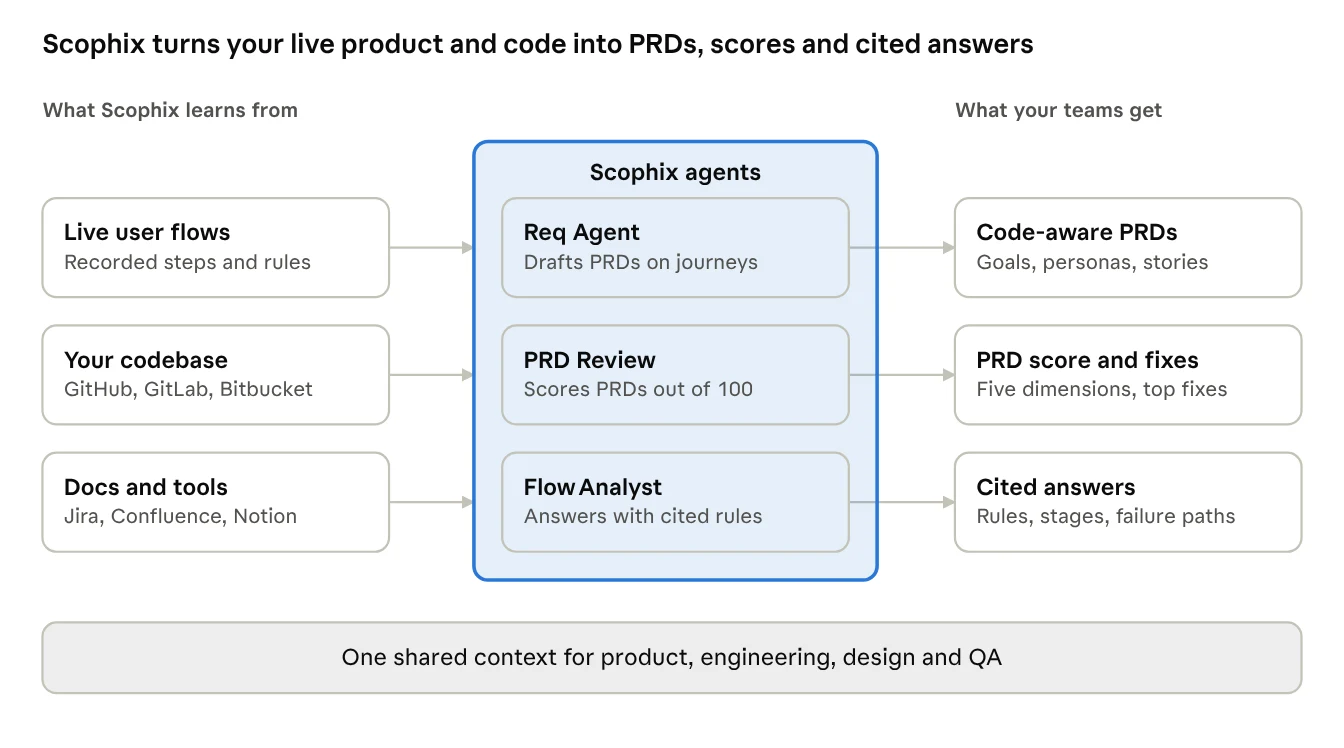
- Capture the product. Click through your live app with the Scophix Chrome Recorder. It captures each step, business rule and decision, and turns real user flows into reusable product knowledge.
- Connect the code and docs. Link GitHub, GitLab, Bitbucket or a local folder, plus Jira, Confluence, Notion, Linear, Slack or Google Drive.
- Build the PRD with Req Agent. Describe the change. Req Agent asks clarifying questions, maps the change onto existing journey stages, and drafts a structured PRD with goals, personas, user stories and scope.
- Enhance it with PRD Review. Upload any PRD, including one written in another tool. Scophix scores it across five dimensions, out of 100, and lists the top fixes.
- Answer questions with Flow Analyst. Anyone on the team can ask how the product behaves. Flow Analyst answers and cites the affected rules, journey stages and failure scenarios.
Built for the whole delivery team
Most product tools are built for the person writing the document. Scophix is built for everyone who has to build, design and test against it.
| Team | What they get from Scophix |
|---|---|
| Product managers | PRDs drafted against real journey stages, scored before hand-off, and answers without chasing subject-matter experts |
| Engineering managers | Requirements that reflect the codebase, and cited answers to "what breaks if we change this?" |
| Design managers | Recorded user flows with the rules and decisions behind each step, before a redesign starts |
| QA managers | Failure scenarios and rules for every flow, so test planning starts the day the PRD does |
Because all four roles share the same context, engineering can join early instead of finding gaps mid-sprint, and QA sees edge cases in the requirement instead of in the bug tracker.
How Scophix differs from today's tools
Product teams now choose from three kinds of AI tools. Feedback and roadmap platforms such as Productboard, Aha! and ProdPad add AI that drafts from customer feedback, ideas and roadmap data. Writing copilots such as ChatPRD draft from what you type or upload. A newer group of code-grounded spec tools, such as Allstacks Product Studio and Rezonant, connect to your repositories so specs reflect the code.
Each solves part of the problem. Unlike any of them, Scophix also learns from the running product itself: it records live user flows, combines them with your code, and gives product, engineering, design and QA one shared context.
| Feedback and roadmap platforms (Productboard, Aha!, ProdPad) | Writing copilots (ChatPRD) | Code-grounded spec tools (Allstacks Product Studio, Rezonant) | Scophix | |
|---|---|---|---|---|
| What the AI learns from | Customer feedback, ideas, roadmap data | Your prompts, uploads and saved project knowledge | Code, tickets, delivery history, docs | Live user flows, code and docs |
| Records flows from the live app | No | No | No | Yes, with the Chrome Recorder |
| Reads your codebase | No | No | Yes | Yes |
| Scores PRD quality | No published scoring | Yes, document scorecards | Yes, readiness scoring (Allstacks) | Yes, five dimensions out of 100 with top fixes |
| Failure scenarios for QA, per flow | No | No | Edge cases flagged while drafting (Rezonant) | Yes |
| Cited answers on how the product behaves | Answers over feedback and roadmap data | Chat over project knowledge | Answers about the code (Allstacks Code Engine) | Yes, citing rules, journey stages and failure scenarios |
| Runs on your own LLM, self-hosted | No | No | Not published | Yes |
Scophix doesn't replace your feedback hub or roadmap. It owns the step between deciding what to build and building it: a requirement that's right about how the product changes, checked against the running product and the code, and shared with everyone who builds and tests it.
Built for the enterprise
Product knowledge and source code are among a company's most sensitive assets. Scophix is designed so security teams can say yes.
- Local-first. On the free desktop app for Windows and macOS, your data stays on your device and is not uploaded to Scophix Cloud.
- Bring your own model. Scophix runs on your own Claude plan or API key. There is no AI markup and no new AI vendor contract.
- Your infrastructure. Scophix Enterprise deploys in your private cloud or self-hosted, with optional centralised sync.
- Enterprise controls. SSO, roles and permissions, audit logs, PRD reviews and approvals, shared workspaces and custom templates.
- Connected to your stack. Jira, Confluence, Notion, Linear, Slack and Google Drive, alongside GitHub, GitLab and Bitbucket.
Scophix is a member of NVIDIA Inception, part of Y Combinator Startup School and Claude for Startups, and recognised by DPIIT Startup India.
Get started
Our promise: your team spends up to 50% less time on product discovery, needs 40% fewer consultations with subject-matter experts, and prepares PRDs twice as fast.
Three ways to see it on your own product:
- Try the Playground. Pick an app, record a flow and get a shareable link, no account needed: scophix.com/playground.
- Download Scophix free. The desktop app is free, with no credit card, and runs on your own Claude plan: Microsoft Store.
- Book an enterprise demo. See Scophix on one of your real flows, with private-cloud and self-hosted options: book a 30-minute call.
Your product already knows how it works. Scophix makes sure your requirements do too.
Sources
- Scophix
- Gartner Peer Insights: AI Product Management Platforms
- Gartner: 40% of enterprise apps will feature task-specific AI agents by 2026
- Gartner: AI Agents Redefine the Discipline of Product Management (April 2026)
- Gartner: Bounded AI Will Define Software Engineering Project Planning Capabilities (August 2026)
- Gartner: Enterprise AI coding agents market enters a new phase (May 2026)
- Atlassian State of Teams 2025, State of Product 2026 and State of Developer Experience 2025, as cited on scophix.com
Competitor capabilities checked November 2026 against: Aha! AI assistant, ProdPad AI features, Productboard Spark, ChatPRD pricing and features, Allstacks Product Studio, Allstacks Product Studio launch and the MakerStack review of Rezonant.